


Cuba Denounces Costa Rica Diplomatic Cut
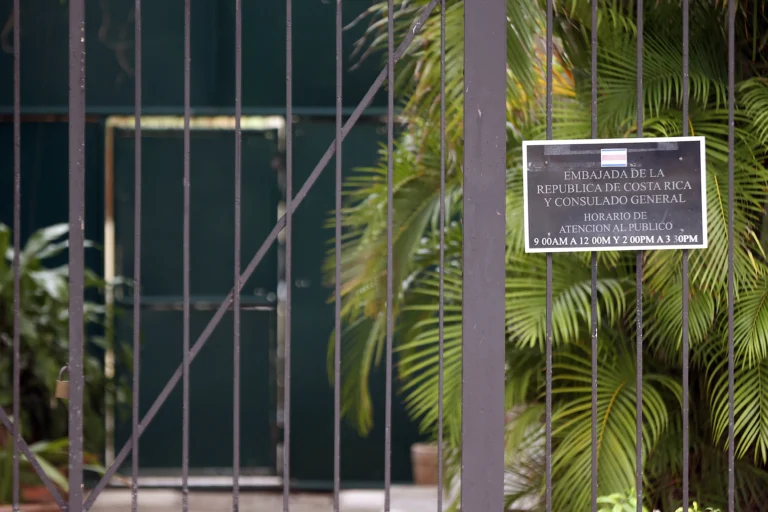
The Embassy of Costa Rica in Havana has no diplomatic staff since last February 5. Photo: EFE.
March 18, 2026 Hour: 6:03 pm
🔗 Comparte este artículo
Costa Rica announced it will reduce diplomatic relations with Cuba to a consular level from April 1, closing its Havana Embassy, a decision rejected by Havana, considered arbitrary and driven by U.S. pressure to isolate the country.
On March 17, Costa Rica’s Ministry of Foreign Affairs formally notified the Cuban Foreign Ministry of its unilateral decision to close its Embassy in Havana.
The diplomatic note, delivered without offering any specific arguments, outlined a significant downgrade in bilateral relations.
RELATED: Diaz-Canel Accuses U.S. of Plotting to Seize Cuba
“We have decided to proceed with the closure of the embassy of Costa Rica in the Republic of Cuba. (…) In the context of this decision, the Government of Cuba is requested to proceed reciprocally with the withdrawal of its diplomatic staff accredited to our country and to maintain only its consular representation”, announced the Costa Rican FM Arnoldo André Tinoco.
Costa Rica requested the withdrawal of Cuban diplomatic personnel from its Embassy in San José, invoking what Havana described as an “unfounded reciprocity.” This measure, set to take effect on April 1, 2026, specifies that only consular and administrative staff from Cuba will be permitted to remain in the country, effectively limiting all official interactions to a consular level.
The official alleged that “deteriorating living conditions of the population” has created a humanitarian context “increasingly complex and make it virtually impossible to appoint Costa Rican diplomatic staff to carry out their work in Havana properly”, deliberately ignoring the over 60-year U.S. blockade against the island and the recent oil sanctions singed by Donald Trump on January, 29 that provokes the current crisis in the Caribbean country.
Text reads: “Communiqué of the Ministry of Foreign Affairs of the Republic of Cuba. Under pressure from the United States, Costa Rica announces the closure of its Embassy in Havana and limits relations with Cuba to consular matters.”
U.S. Alignment Against Cuba
Cuba’s Ministry of Foreign Affairs immediately condemned the move as an arbitrary decision, one clearly adopted under external pressure and without due consideration for the national interests of the Costa Rican people.
Havana views this action as yet another instance of the Costa Rican Government’s historical alignment with United States policy against Cuba. This move, according to Cuba, directly contributes to Washington’s renewed attempts to isolate the island nation from the countries of the region and participates in an aggressive escalation against the Cuban Revolution, a stance widely rejected by the international community.
The timing of this decision aligns with a broader pattern of U.S. efforts to exert influence over Latin American nations, particularly those with independent foreign policies.
Historically, the United States has employed various diplomatic and economic pressures to shape regional alignments, often attempting to undermine solidarity and integration among countries in the Global South.
Cuba’s Integration Reaffirmed
The Cuban Foreign Ministry emphasized that such attempts to isolate Cuba are destined to fail, much like similar efforts 60 years ago during the height of the Cold War. Despite governmental actions, the statement highlighted the indissoluble bonds that unite the peoples of Cuba and Costa Rica, forged through a shared history and the legacy of great independence heroes like José Martí and Antonio Maceo. These deep cultural and historical connections, it argues, transcend political decisions and continue to foster mutual respect and solidarity between the two nations.
Cuba has reiterated its unwavering commitment to international law, mutual respect, and the principles of national sovereignty. The Ministry of Foreign Affairs stressed that while it regrets Costa Rica’s unilateral decision, its foreign policy will continue to prioritize dialogue, cooperation, and the defense of its national interests against any form of external coercion.
The Cuban Government will continue to extend its hand to the Costa Rican people, reaffirming that the bonds between their populations will endure, regardless of fluctuating political tides or geopolitical pressures.
A decision by a neighboring nation to limit diplomatic engagement, especially under perceived external influence, can complicate the integration efforts and create precedents that other nations might be pressured to follow. Such actions risk fragmenting regional unity at a time when collective action on shared challenges, from climate change to economic development, is increasingly vital.
Cuba has consistently faced such pressures, yet its commitment to sovereignty and its revolutionary principles remains steadfast, as underscored by its firm response to this latest diplomatic maneuver.
Text reads: “The U.S. publicly threatens Cuba, almost daily, to overthrow the constitutional order by force, using an outrageous pretext: the harsh constraints of the weakened economy that they have attacked and sought to isolate more than six decades ago. They claim and announce plans to take over the country, its resources, properties, and even the very economy that they seek to suffocate in order to surrender us. Only this explains the fierce economic war being waged as collective punishment against the entire people. In the worst-case scenario, Cuba is accompanied by a certainty: any external aggressor will face impregnable resistance.”
Author: Lauraa V. Mor
Source: Cuban Ministry of Foreign Affairs